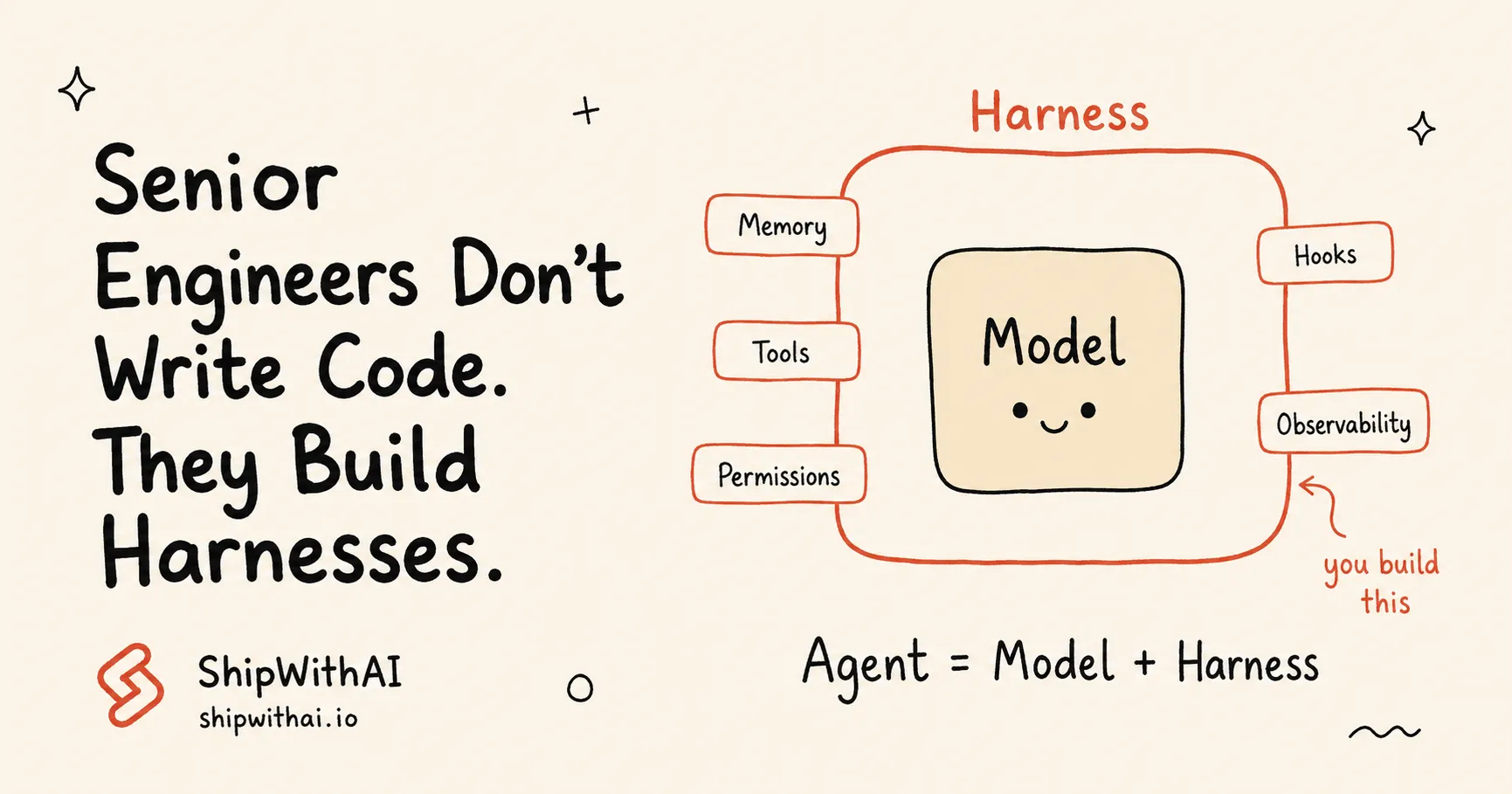
TL;DR - The highest-leverage activity for senior engineers in 2026 isn’t writing code. It’s building the 5-layer harness (memory, tools, permissions, hooks, observability) that makes every team member’s AI output reliable. One harness, committed to version control, serves 10 developers. Jump to the 5-layer system →
📊 What this post covers:
- The trust paradox: 84% AI adoption, 29% trust, and what closes the gap
- 4-era leverage evolution from writing code to building harnesses
- The 5-layer harness system as a senior engineer’s primary output
- Team multiplication math: 1 harness x 10 developers
- A harness review checklist you can use in your next PR
84% of developers use AI coding tools.29% trust what they produce.
That 55-point gap is the senior engineer's new job.
Not a new model. Not a better prompt. A better system around the model.
The gap between adoption and trust exists because developers adopted AI tools without building the systems to verify, constrain, and correct their output. The tool works fine. The harness is missing. And building that harness is the new leverage point for senior engineers.
This post is the capstone of the Harness Engineering series. Previous posts covered each layer of the system. This one answers the career question: why should you, specifically, care about any of it?
Why is AI adoption high but trust low?
Developer AI tool adoption reached 84% in 2025, with 51% using AI tools daily (Stack Overflow Developer Survey, 2025). But trust in AI-generated code dropped from 40% to 29% over the same period (ShiftMag, 2025). Adoption climbed while trust fell. That divergence tells you everything.
The pattern looks like this: developer installs AI tool, generates code, eyeballs it, ships it. Works for prototypes. Breaks in production. After the third rollback, trust erodes. After the fifth, the team lead starts asking why they’re paying for this. (For a broader view on where AI is actually headed — away from apocalypse, toward decades of messy transition — the case that AI won’t end the world is worth a read.)
The problem isn’t the model. The model generates reasonable code most of the time. The problem is that nothing verifies the output, nothing constrains the dangerous actions, and nothing remembers what went wrong last session.
Without harness:  Developer → AI generates code → eyeball it → ship it → hope  Trust trajectory: down
With harness:  Developer → AI generates code → hooks verify → constraints block bad actions → memory prevents repeat mistakes  Trust trajectory: up
The tool is the same in both cases. The system around it isn’t.
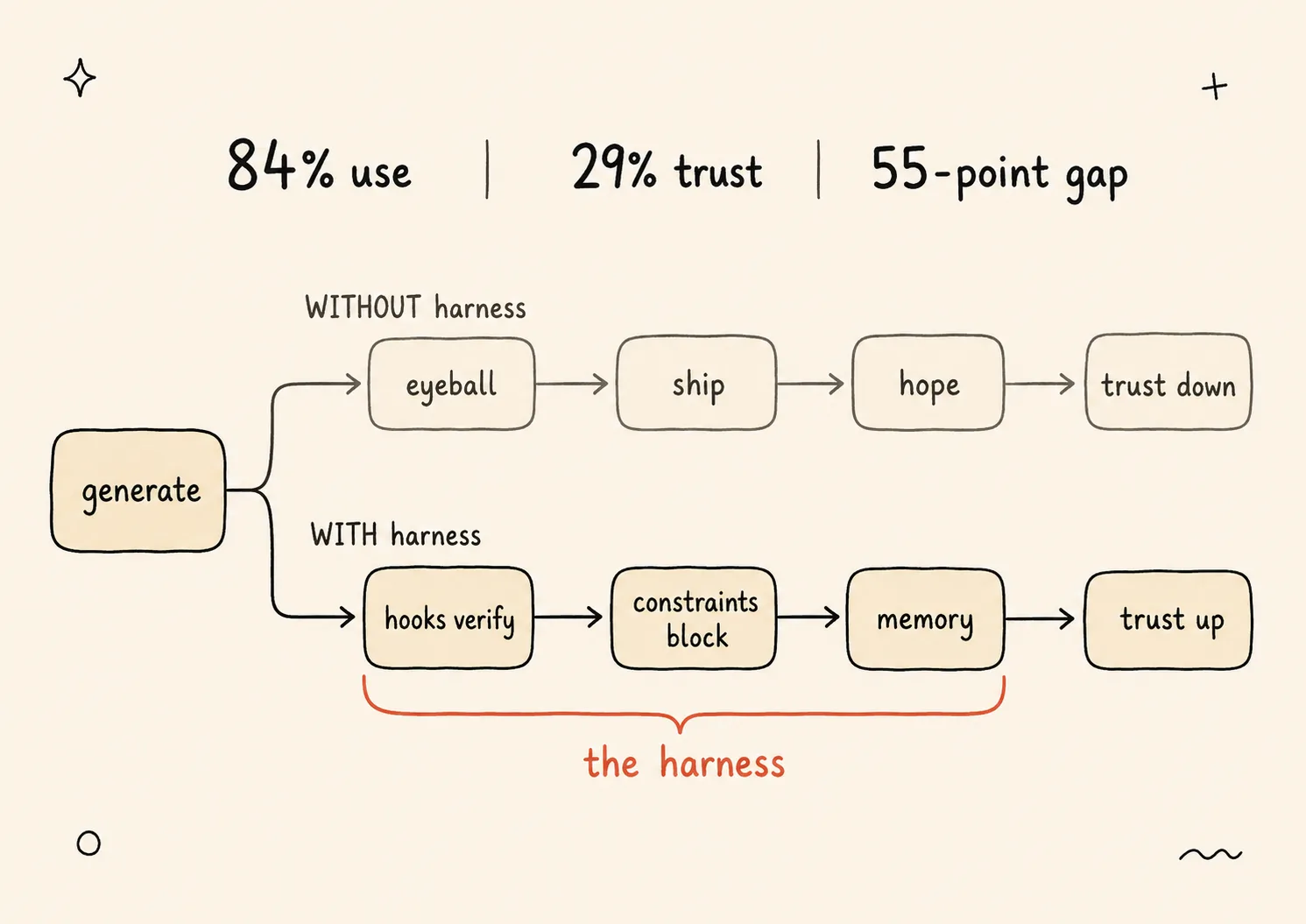
Same model, same code — the only difference is the harness inserted in the middle: verify, constrain, remember. That’s what turns the trust line from down to up.
Where does senior engineer leverage live now?
The leverage point for senior engineers has shifted four times in six years. Each shift multiplied output and made the previous skill table stakes. The current shift, from curating context to building harnesses, is the one most senior engineers haven’t made yet (Fowler, 2026).
| Era | Years | What You Optimize | Your Leverage |
|---|---|---|---|
| Write good code | Pre-2023 | Algorithms, architecture | Your typing speed and design skill |
| Write good prompts | 2023-2024 | Instructions to the model | How well you phrase requests |
| Curate good context | 2025 | What the model sees | CLAUDE.md, context windows, RAG |
| Build good harnesses | 2026 | The system around the model | Hooks, verification, constraints, memory |
Each era didn’t replace the previous one. It absorbed it. You still need to write good code. You still need good prompts. You still need good context. But the leverage multiplier is now in the harness layer, not the layers below it.
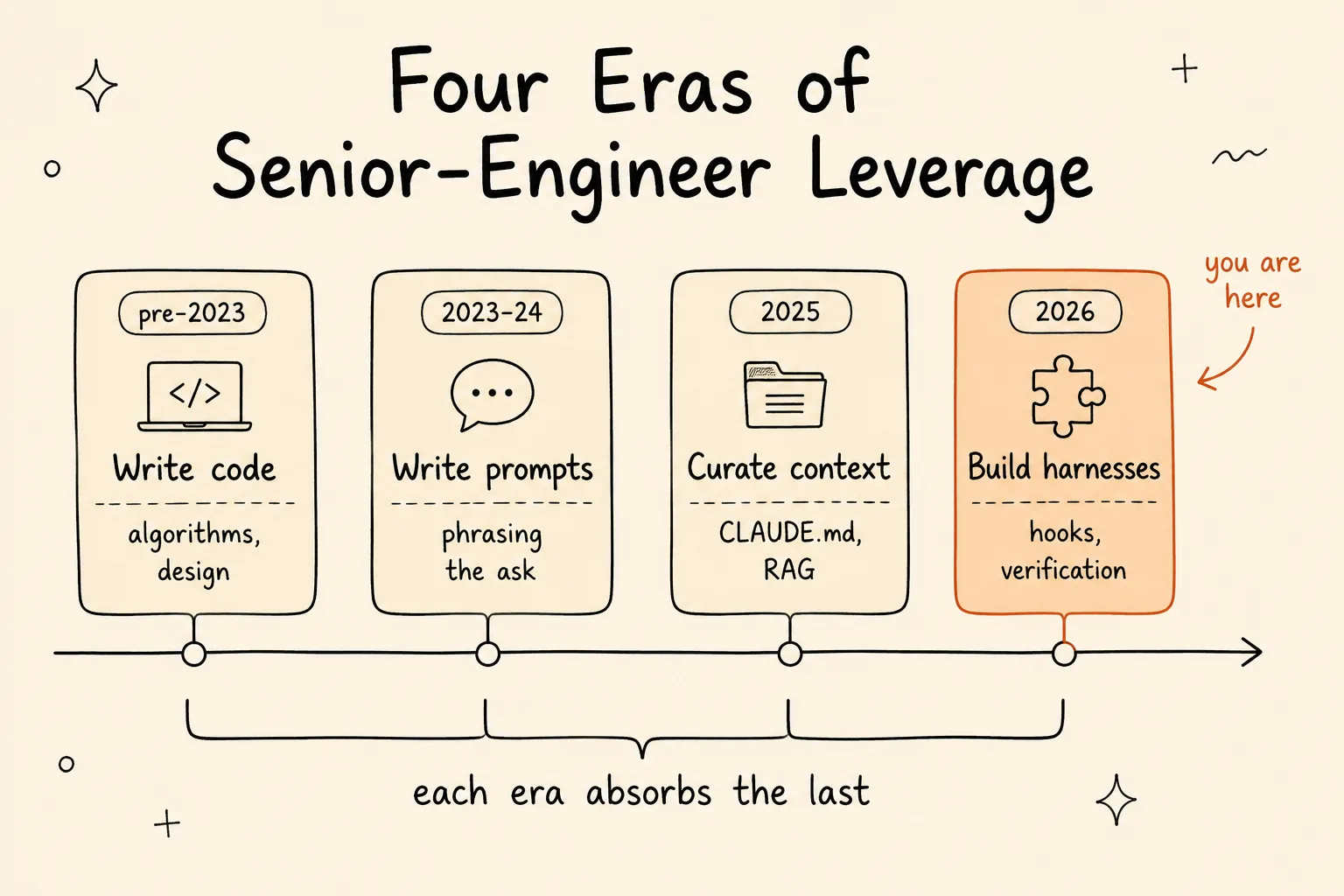
The leverage point has moved four times in six years — from code, to prompts, to context, to the harness. Each shift absorbed the last; the multiplier now lives in the harness layer.
LangChain proved this with numbers. Same model (gpt-5.2-codex), same prompts, same context window. Three harness changes: context injection, self-verification loops, and compute budget management. Result: 52.8% to 66.5% on Terminal Bench 2.0, a jump from Top 30 to Top 5 (LangChain Blog, 2026).
The model was never the bottleneck. The harness was.
What does a 5-layer harness system look like?
A production harness has five layers: memory, tools, permissions, hooks, and observability. Each layer compounds the reliability of the layers below it. Building them in order (1, then 4, then 2, then 3, then 5) produces the fastest ROI. Most developers stop at Layer 1 (ShipWithAI 5-Layers guide).
| Layer | What It Does | Deep Dive | Example |
|---|---|---|---|
| 1. Memory | Persistent context | CLAUDE.md + MEMORY.md | ”Use Clerk not NextAuth” persists across sessions |
| 2. Tools | Extended capabilities | 5 Layers | MCP server for database queries |
| 3. Permissions | Safety boundaries | 5 Layers | Block rm -rf, allow npm test |
| 4. Hooks | Verification loops | Verification Loop | PostToolUse runs ESLint after every file edit |
| 5. Observability | Audit + cost tracking | 5 Layers | Token cost alerts at $2/session |
Here’s why the order matters. Memory (Layer 1) is free. You create a CLAUDE.md file with your project’s rules, and every session starts with the right context. That alone eliminates the “explaining Clerk for the 6th time” problem.
Hooks (Layer 4) come next because they enforce rules that memory can only suggest. A CLAUDE.md line saying “run tests before committing” gets ignored under pressure. A PostToolUse hook (a script that runs automatically after every tool action) that runs npx eslint --quiet after every file edit cannot be bypassed. Memory advises. Hooks enforce.
The rest fills in from there. Tools extend what the agent can do. Permissions restrict what it’s allowed to do. Observability tells you what it actually did.
One afternoon of setup. Every session after that is more reliable.
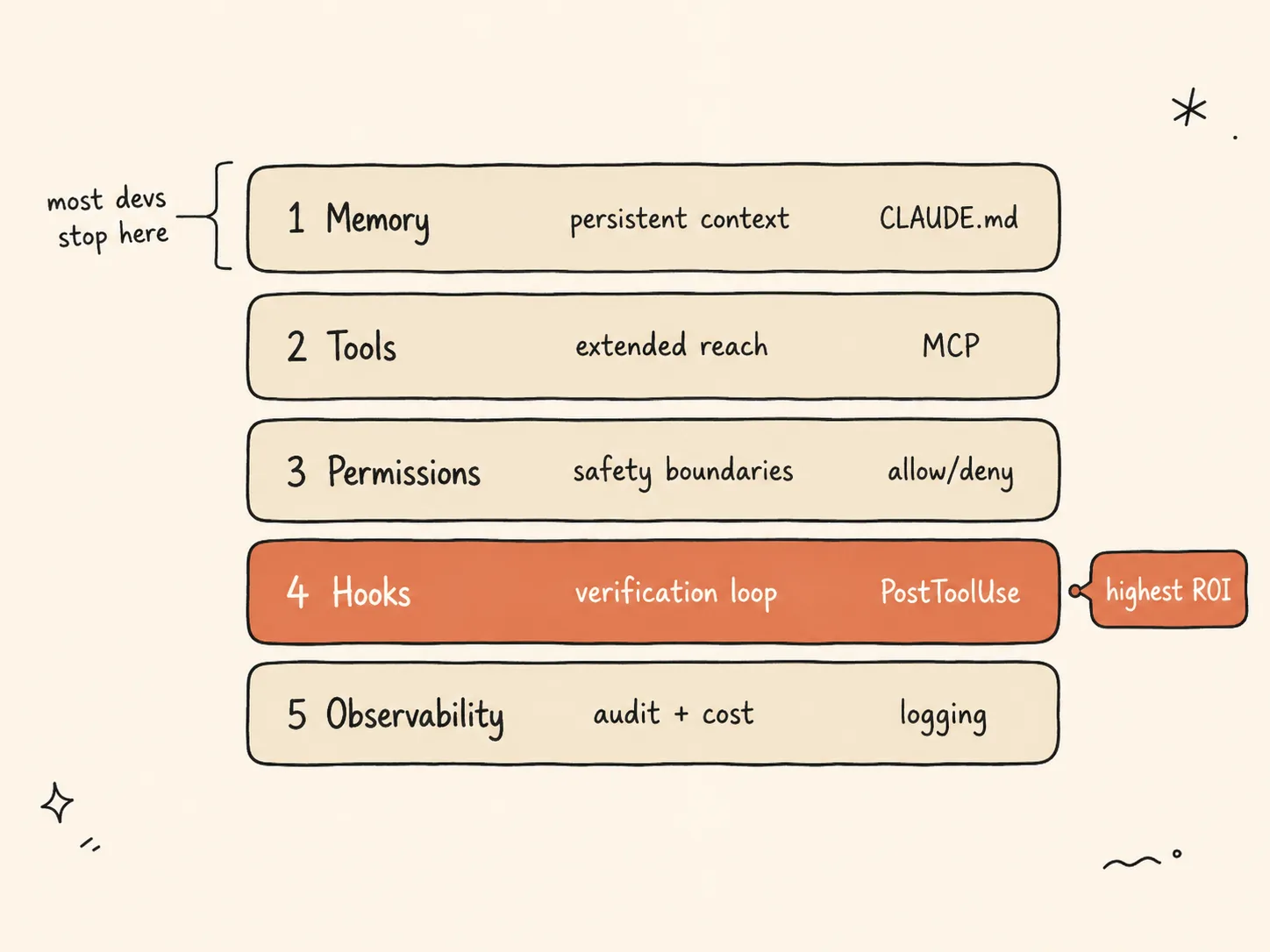
A production harness is five layers. Most teams have only Layer 1 (CLAUDE.md); adding Layer 4 (hooks) has the highest ROI because hooks enforce what memory can only advise.
How does one harness multiply a team of 10?
A harness committed to version control gives every developer on the team the same verification loops, the same constraints, and the same memory. One staff engineer’s afternoon of harness work replaces 10 developers’ daily context-rebuilding. OpenAI’s Codex team shipped 1,500 PRs with just 3 engineers using this principle, building the harness once and letting it compound (Fowler, 2026).
Three levels of multiplication:
Individual harness: Your CLAUDE.md, your hooks, your MEMORY.md. It lives in the repo. Every git clone inherits it.
.claude/ settings.json # Hook configs, permission rulesCLAUDE.md # Static rules, constraints, failure logMEMORY.md # Evolving state, active decisionsTeam harness: Shared MCP servers, shared hook configs, shared MEMORY.md entries for active migrations. When you add a constraint after a production incident, every team member gets it on their next git pull.
Organizational harness: Standard hook templates across repositories. Compliance hooks that prevent secrets in commits and block force pushes to main. The security team writes it once, every repo inherits it.
The multiplication math is straightforward:
Without harness:  10 developers x 15 min/session rebuilding context = 2.5 hours/day wasted  Monthly: ~50 hours lost
With harness:  Setup: 4 hours (one staff engineer, one afternoon)  Daily savings: 2.5 hours  ROI positive: day 2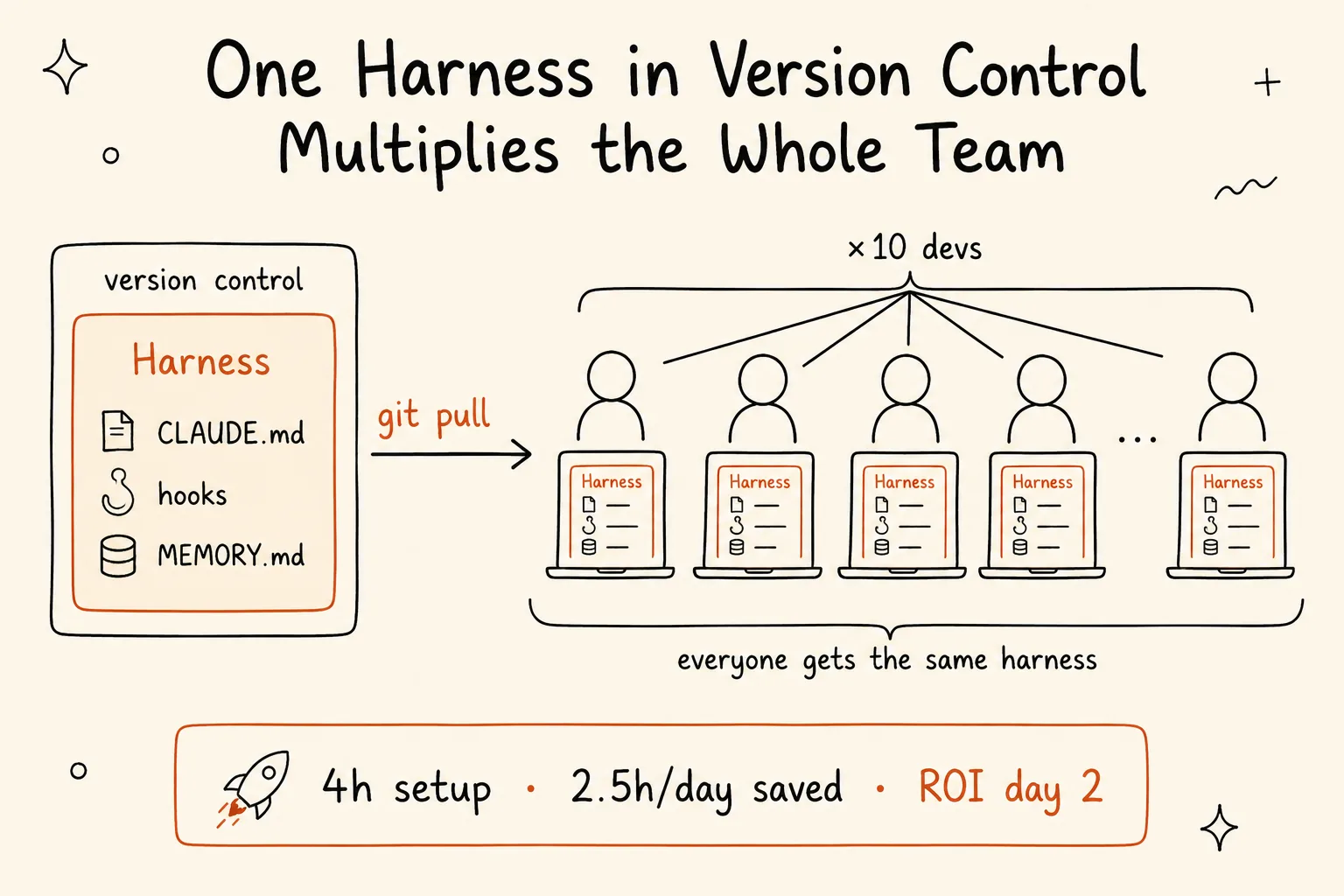
One harness committed to the repo hands every developer the same verification loops, constraints, and memory on their next git pull — one afternoon of setup, ROI positive by day 2.
This is why staff engineer job descriptions at major tech companies increasingly mention “developer experience” and “tooling.” Harness engineering is developer experience for the AI era. You’re not writing code. You’re building the system that makes everyone else’s AI-generated code reliable.
Want the full Harness Engineering system? Five layers, from memory to observability. Get the weekly breakdown of what works in production. Subscribe to AI Developer Weekly →
What should you review in a harness instead of just code?
Code review catches bugs in implementation. Harness review catches bugs in the system that produces implementation. When AI-authored code reached 41% of all new code in 2026 (Modall, 2026), reviewing the system that generates it became as important as reviewing the code itself.
Here’s a harness review checklist. Use it alongside your existing code review process:
Harness Review Checklist:
  Memory:  [ ] CLAUDE.md reflects current tech stack and constraints  [ ] MEMORY.md has been pruned in the last 30 days  [ ] No stale entries pointing to removed files or old decisions
The memory section catches context drift. If your CLAUDE.md still says “Prisma ORM” but you migrated to Drizzle two weeks ago, every AI session starts with wrong assumptions. The failure log pattern keeps memory sharp.
Hooks: [ ] PostToolUse verification exists for file edits [ ] Stop hook exists for destructive commands [ ] Hook configs are committed to version control (not local-only)The hooks section catches enforcement gaps. If your team has a rule about running tests before commits but no hook enforces it, the rule is advice, not a constraint. The constraint paradox explains why this distinction matters.
  Constraints:  [ ] Allowed commands list matches CI/CD requirements  [ ] No wildcard permissions on production-affecting tools  [ ] Sensitive files (.env, credentials) excluded from agent access
  Cost:  [ ] Session cost alerts configured  [ ] Context window usage monitored  [ ] Unnecessary files excluded from context
Add this checklist to your PR template. It takes 2 minutes to run and catches the class of bugs that code review can’t see: configuration drift, missing enforcement, stale context.
Build your first team harness
The fastest path from zero to working team harness takes six steps and about 30 minutes. You pick one repo, add three files (CLAUDE.md, MEMORY.md, .claude/settings.json), and commit them. Every developer who pulls that repo inherits the full system. No per-developer setup required.
Try it now:
- Pick one repo your team uses daily
- Audit the CLAUDE.md: does it reflect current tech stack? Add 3 constraints from recent bugs using the failure log pattern
- Add one PostToolUse hook: ESLint after file edits. Copy the config from the verification loop post
- Create MEMORY.md with 5 pointer entries for active work. Follow the MEMORY.md setup guide
- Commit the harness files:
CLAUDE.md,MEMORY.md,.claude/settings.json- Run the harness review checklist above in your next PR review
Every git pull now gives your entire team the same system. One afternoon of setup. Compounding returns from day 2.
FAQ
What is harness engineering for AI coding agents?
Harness engineering is the practice of building the system around an AI model (memory, tools, permissions, hooks, observability) to make the agent reliable in production. The term was formalized by Birgitta Bockeler on Martin Fowler’s site and OpenAI in early 2026. The core formula: Agent = Model + Harness. The model is a commodity. The harness is your competitive advantage.
Do senior engineers still write code with AI agents?
Yes. But the leverage point has shifted. Senior engineers spend more time building harnesses (CLAUDE.md, hooks, verification loops, MCP servers) that make every team member’s AI output more reliable. Writing code is still part of the job. It’s just no longer the highest-leverage activity.
How long does it take to set up a Claude Code harness?
A basic harness (CLAUDE.md + one verification hook + MEMORY.md) takes about 30 minutes. A full 5-layer system takes 2-4 hours. For a team of 3+ developers saving 15 minutes per session each, the ROI is positive within 2 days. The 5-Layers guide walks through each layer with setup instructions.
Can harness engineering work for any AI coding tool?
The principles (persistent memory, verification loops, constraints, observability) apply to any agent. The implementation differs by tool. Claude Code has hooks and CLAUDE.md. GitHub Copilot has .github/copilot-instructions.md. Cursor has .cursorrules. The harness pattern is universal. The config files are tool-specific.
Start building your harness today. Layer 1 takes 5 minutes. The rest compounds from there. Subscribe for weekly Claude Code insights →
What to Read Next
- Harness Engineering: The System Around AI Matters More Than AI - Start here if you haven’t read the series. The pillar post that defines harness engineering with the Agent = Model + Harness formula and the 5-layer overview.
- Claude Code Harness: 5 Layers Beyond CLAUDE.md - The architectural blueprint for the 5-layer system referenced throughout this post. Includes setup order and implementation for each layer.
- Build a Self-Verification Loop for Claude Code - The most impactful single harness change: a 3-layer verification system using hooks. Copy-paste configs included.


